Founder Dependency: The Real Reason Your Business Won’t Scale Without You

You built this company from nothing. You know every client by name, every line of code, every nuance of the service delivery. In the early days, this “heroic” involvement was your superpower. It was the grit that allowed you to survive while competitors failed.
But now, that same superpower has become your kryptonite.
You have hit a revenue ceiling. Not because there is no market demand, and not because your product is weak. You have hit a ceiling because your organization’s operational capacity is strictly limited to your personal bandwidth.
If you step away for a month, does the revenue grow, or does the machine grind to a halt? If the answer is the latter, you are suffering from Founder Dependency.
Most leaders try to fix this by hiring “better” managers or writing endless Standard Operating Procedures (SOPs). They are often shocked when these fixes fail. The reason is simple: Founder Dependency is not a people problem. It is not a process problem.
It is a cultural level problem.
The “Hero” Trap: Why Success Feels Like Punishment
There is a cruel irony in scaling a business. You work hard to buy your freedom, but as the company grows, you often end up with less of it.
You might see these symptoms in your daily operations:
- The Approval Bottleneck: Your team waits for your “green light” on decisions they should be able to make themselves.
- The “Firefighter” Syndrome: You spend 80% of your day solving operational crises instead of thinking strategically.
- The SOP Paradox: You have documented processes, yet people still ask, “What should I do?”
- The Revenue Plateau: You can’t take on more clients because you can’t clone yourself.
This exhaustion isn’t a badge of honor. It is a warning light on your dashboard. It signals that your organization is trapped in the lower levels of cultural maturity.
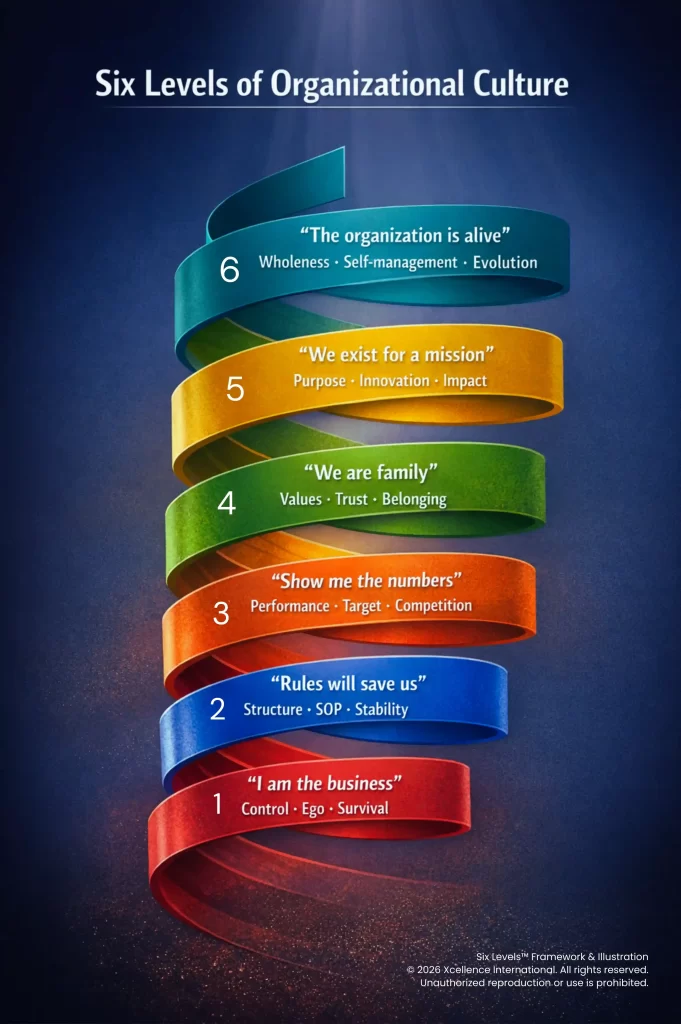
Diagnosing Your Level: The 6 Levels of Organizational Culture
To solve Founder Dependency, you must first understand where your organization currently lives. Based on our framework at Xcellence International, every company operates at a dominant cultural level.
Founder Dependency thrives in the transition between Level 1 and Level 2.
Level 1: Chaos (The Founder-Dependent Phase)
This is where every startup begins. Speed is high, structure is low. The culture is purely defined by the founder’s personality.
- The good: Decisions are instant.
- The bad: Everything depends on you. If you get sick, the company gets sick.
- The trap: Many founders love the adrenaline of Level 1, but you cannot scale Chaos.
Level 2: Bureaucracy (The “SOP” Fix)
Desperate to escape the chaos, founders usually over-correct. They implement rigid rules, heavy KPIs, and strict hierarchies.
- The result: You trade chaos for paralysis.
- The symptoms: “Rules replace thinking.” Employees stop taking initiative because they are afraid of breaking a rule. They become passive operational drones.
This is where most scaling efforts die. You moved from “everything relies on me” (Level 1) to “everything relies on the rules I made” (Level 2). You still haven’t unlocked the autonomy required for true growth.
To break through this ceiling, you don’t just need more rules. You need to redesign the behavioral systems of your company to reach Level 5 (Purpose) and Level 6 (Self-Managed).
This is rarely something a founder can do alone from the inside, because the founder is the system that needs changing. This is where engaging an organizational culture transformation consultant becomes a strategic necessity, not just a luxury.
Why You Can’t “Hire” Your Way Out of This
A common objection we hear from founders is: “I just need to hire a COO or better senior leaders to take this off my plate.”
Here is the hard truth: You cannot insert A-player leaders into a Level 2 culture and expect Level 6 results.
If your cultural operating system is built on dependency (Level 1) or rigid compliance (Level 2), high-performing leaders will either:
- Leave because they feel micromanaged.
- Regress and become passive order-takers to survive.
You are trying to run high-performance software (great people) on an obsolete operating system (broken culture).
As discussed in our analysis of Leadership Maturity, the growth of the organization can never outpace the maturity of its leadership culture. If you simply add people without upgrading the culture, you are just adding complexity to dysfunction.
The Way Out: Moving Toward a Self-Managed Organization
Defeating Founder Dependency requires moving your organization toward Level 6: Self-Managed.
In a Self-Managed culture:
- Teams operate without constant intervention.
- Authority is distributed to those closest to the information, not those with the biggest title.
- Accountability is horizontal (peer-to-peer), not just vertical (boss-to-employee).
Case Study: The $50M Ceiling
(Anonymized for client privacy) We worked with a manufacturing client stuck at a revenue plateau. The founder was working 14-hour days approving purchase orders and mediating disputes between departments (classic Level 3 Competition culture).
By restructuring their decision-making flows and implementing a “Purpose-Driven” framework (Level 5), we shifted the burden of decision-making. Within 6 months, the founder moved from operational approval to strategic oversight. The company grew 40% the following year—without the founder working a single weekend.
The Role of the Consultant
The journey from Chaos (Level 1) to Self-Managed (Level 6) is treacherous. It involves dismantling the very habits that made you successful in the early days.
This is why generic business coaches often fail here. They give you advice, but they don’t change the mechanics of how your team interacts.
You need culture transformation experts who do more than run workshops. You need partners who will:
- Diagnose the hidden bottlenecks in your decision-making structure.
- Redesign accountability systems so they don’t rely on your oversight.
- Empower your team to take true ownership of the company’s growth.
Conclusion: Choose Your Pain
You have two choices.
You can keep the control you have now, and accept that your business will never grow larger than your personal energy allows. That is the pain of stagnation.
Or, you can accept the discomfort of transformation. You can dismantle the systems of dependency and build a culture that stands on its own. That is the pain of growth.
If your business collapses when you step away, you don’t have a business; you have a high-paying job. It’s time to build an organization that can outlast you.
Are you ready to move beyond Bureaucracy and build a scalable, Self-Managed company?
Book a Strategic Conversation with Xcellence International today.