Daniel closed the biggest quarter of his career and got a standing ovation at the town hall. Six weeks later, an anonymous tip landed in HR: he had been quietly inflating his pipeline numbers for two quarters, and three people on his team had been resigning in slow motion because he took credit for their deals. Nobody was shocked. Everyone had seen it coming. Nobody had said anything, because saying something meant questioning the numbers, and the numbers were the only language the company still spoke.
This is what a performance-driven culture risk actually looks like from the inside. Not villains. Just very good people, optimizing exactly what they were told to optimize.
Why This Level Feels Like Winning
KPIs, meritocracy, targets, rankings. A performance-driven culture arrives promising something intoxicating: the end of politics, the start of pure merit. Anyone can rise, the story goes, if the numbers are good enough. For a while, that promise is real. Quiet performers who were invisible under the old hierarchy suddenly get noticed. Energy floods the building. Revenue climbs like it has never climbed before.
MIT Sloan Management Review’s research found that a toxic corporate culture is 10.4 times more powerful than compensation in predicting whether a company loses its best people. A performance-driven culture risk hides inside that statistic, because the metrics that look objective on a dashboard are frequently the exact mechanism manufacturing the toxicity underneath it.
The Moment Merit Becomes a Weapon
Here is the part that never makes it into the KPI dashboard. The instant an organization makes performance the highest value it has, it has also made betrayal the highest skill. Not because people are naturally cruel, but because the system has quietly told them that someone else’s failure is their own opportunity.
Colleagues stop being collaborators and start being competitors for the same finite pool of recognition. Information gets hoarded instead of shared, because sharing it might help a rival hit their number first. A performance-driven culture risk rarely announces itself as sabotage. It arrives as “healthy competition,” right up until the sabotage is too obvious to deny.
The Talent the Scoreboard Cannot See
The scoreboard rewards whoever crosses the finish line first, not whoever built the track everyone else is running on. The person quietly mentoring three junior hires, the one flagging a problem before it becomes a crisis, the one who took a smaller deal so a struggling teammate could hit quota, none of that shows up on a leaderboard. A performance-driven culture risk systematically starves the exact behaviors that make an organization durable, because durability was never what got measured.
The International Team That Turned Into a War Room
Watch what happens when a performance-driven culture risk crosses borders. Regional teams competing for the same global recognition budget stop sharing best practices with each other, because a competitor’s win now costs them their own ranking. Leaders who once collaborated across markets start hoarding intelligence, quietly hoping a sister office stumbles. The company looks unified on an org chart and functions like five companies at war, all wearing the same logo.
Executives are often the last to see it, because the version reported upward always looks like healthy ambition. Nobody sends a status update that says “I sabotaged a peer’s numbers this quarter.” What leadership sees is a chart going up and to the right. What the floor experiences is a performance-driven culture risk quietly convincing capable people that loyalty to the company and loyalty to their own survival are two different things. This is the same mechanism explored in Information Distortion in Large Organizations: Why Leaders Only Hear Good News, where the filtering happens for the same reason: telling the truth upward carries risk, and softening it does not.
Why Leaders Keep Doubling Down
The instinct, when growth slows inside a performance-driven culture, is almost always to add more metrics. More dashboards. Tighter KPIs. Sharper rankings. It rarely works, because the problem was never a lack of measurement. It was measuring the wrong thing loudly enough that everything else stopped mattering.
A performance-driven culture risk is self-reinforcing precisely because the people most rewarded by it are the ones now running it. Asking them to loosen the system that made them successful is asking them to unwind their own advantage, which is why the fix almost never comes from inside the leaderboard’s own top ranks.
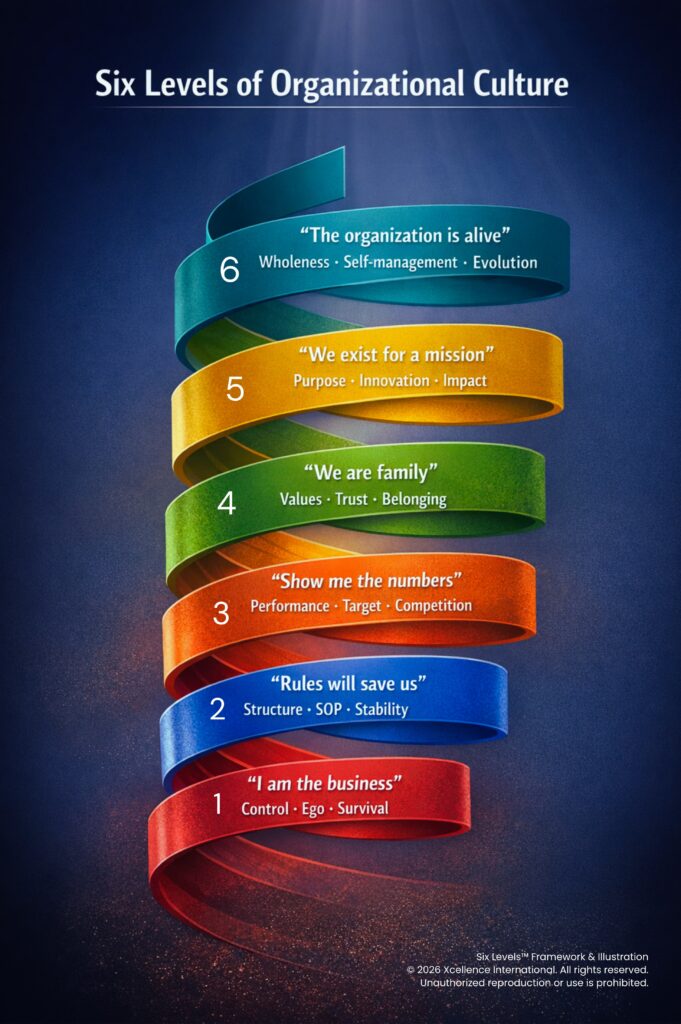
What This Predicts on the 6 Levels of Culture
This is level three of the 6 levels of culture, the most seductive level of all, because the results are real even while the culture underneath them is quietly rotting. Revenue can climb for years inside a performance-driven culture risk before the cost shows up, usually all at once, in a resignation wave, a scandal, or a star performer who finally breaks in public the way Daniel did.
The fix is not abandoning performance. It is refusing to let performance be the only thing measured. What gets rewarded gets repeated, and right now, in a performance-driven culture risk, the thing being rewarded is whoever wins today, regardless of what it costs the team tomorrow.
Frequently Asked Questions
What is performance-driven culture risk?
Performance-driven culture is Level 3 of the 6 levels of culture: KPIs and meritocracy replace the rules of bureaucratic culture. It produces real results, but MIT Sloan Management Review found a toxic culture is 10.4 times more powerful than pay in predicting whether a company loses its best people, and this is the level where that toxicity usually gets manufactured.
Why does a performance-driven culture create office politics?
The instant an organization makes performance the highest value it has, it makes betrayal the highest skill. Colleagues become competitors for the same finite pool of recognition, so information gets hoarded instead of shared.
What comes after performance-driven culture?
Level 4, family culture, replaces competition with belonging and trust. It solves the burnout of Level 3 but introduces a different risk: accountability disappears in the name of kindness. See Family Culture Business Risk: Kindness Over Accountability.
Daniel’s team eventually recovered. Two of the three people who nearly quit stayed, once new leadership started rewarding the behavior nobody had bothered to measure before, the mentoring, the flagged risks, the deals they let a struggling teammate close instead of grabbing for themselves. Which behaviors is your scoreboard currently punishing without meaning to, and which quiet contributor is about to walk out the door because your dashboard never learned how to see them? Book a Strategic Conversation with Xcellence International and find out what your KPIs are actually optimizing for.