Alex Walker was never lazy. He was never foolish. He was exactly the kind of leader people admire, decisive, tireless, unstoppable. That is precisely what made him dangerous.
Because the leader who fails is rarely the weak one. It is the strong one, burning himself alive one rescue at a time, and calling it dedication. That is the trap at the center of my own book, The Inner Evolution of a Leader. The character is fiction. The trap is not.
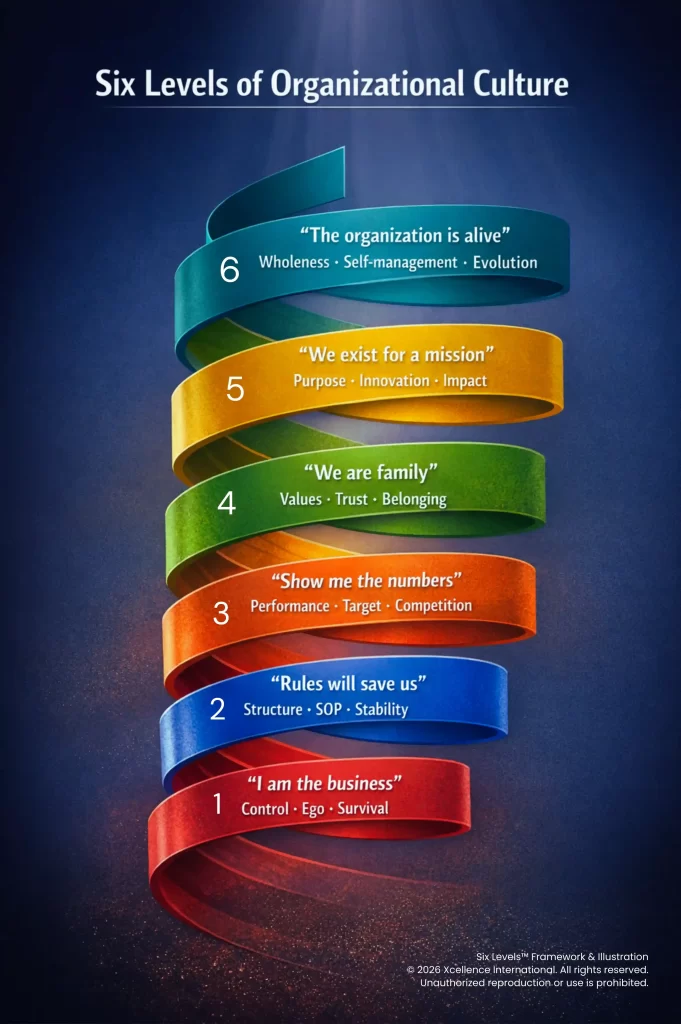
Every leader I have ever sat across a table from is running one of the 6 levels of culture, whether they can name it or not. Most spend their entire career trapped in the first three, mistaking the trap for a strength, right up until the fire they started starts consuming them.
What the 6 Levels of Culture Framework Actually Exposes
Forget the poster on the wall. Forget the values workshop nobody remembers by Friday. The 6 levels of culture model measures one brutal thing: where authority lives, and what the organization trusts when nothing forces the truth to come out.
At the bottom, authority lives in one exhausted person’s judgment, and everything waits on him. At the top, authority lives everywhere, and the organization runs without anyone standing guard. In between sit four levels that all feel like progress and all quietly become a prison, because a stable company can still be dying.
The Six Levels, and the Lie Each One Tells Its Leader
Level 1: “I Am the Business”
The leader carries everything, until carrying everything starts to destroy him. He decides, corrects, rescues, and the business breathes because his fire is everywhere. The lie he tells himself is that this is strength. The truth is the company has not become strong. It has become dependent, and it will collapse the day he cannot show up. Full breakdown: Founder-Led Culture: Why the Business Dies With the Founder.
Level 2: “Rules Will Save Us”
Structure arrives to save the leader from himself, SOPs, hierarchy, reporting lines, and for a moment it feels like salvation. The chaos is gone. Everyone can finally breathe. Then the staff start hiding behind the rules instead of living by them, departments turn into silos, and the leader wakes up one day realizing his beautifully organized company has quietly stopped reaching for anything. Full breakdown: Bureaucratic Company Culture: When Rules Replace Judgment.
Level 3: “Show Me the Numbers”
This is the most seductive level of all. KPIs, meritocracy, targets, and suddenly the invisible people become stars and the numbers climb like a fever. It feels unstoppable, right up until the moment a leader realizes his own people are sabotaging each other’s scores to survive, because the instant you make performance the highest value, you have made betrayal the highest skill. Full breakdown: Performance-Driven Culture Risk: The Cost of Chasing KPIs.
Level 4: “We Are Family”
Trust returns. Belonging becomes the glue. People finally feel safe enough to stay. But safety has a cost nobody warns you about, the edge that built the company quietly disappears, because nobody wants to be the one who says the hard thing to family. Full breakdown: Family Culture Business Risk: Kindness Over Accountability.
Level 5: “We Exist for a Mission”
A purpose bigger than any single person pulls in the star players willing to bleed for an impossible goal. The alignment is extraordinary. So is the burnout, because a mission this size has no natural ceiling and nobody dares to say stop. Full breakdown: Purpose-Driven Culture: The Mission That Has No Ceiling.
Level 6: “The Organization Is Alive”
Units run themselves, hire themselves, resolve their own conflicts, with no manager standing in the loop. This is the rarest level in any enterprise, and the hardest to fake, because it demands leaders hand over control they spent a career fighting to earn. Full breakdown: Self-Managed Organization: The Rarest Culture Level.
The Uncomfortable Truth Most Leaders Never Hear
Most leaders do not fail because they are weak. They fail because they are strong, at the wrong level, and everyone around them mistakes the strength for the whole story. McKinsey’s own 2026 research found that 75 percent of organizations are still struggling to build a high-performance culture, with budgets and talent that should have solved this years ago. That is not a resourcing problem. It is a level problem, and money cannot buy your way past it.
Most global companies, multinationals included, are still trapped somewhere between Level 2 and Level 4 of the 6 levels of culture. They outgrew the founder, but never built what comes after him. This exact gap, complexity racing ahead of maturity, is the silent crisis explored in When Organizational Growth Outpaces Leadership Maturity.
The Blind Spot That Keeps a Leader Stuck
Leaders trapped at Level 2 or 3 all share one habit, they trust whatever looks measurable over whatever is actually true. A price on a quote looks objective, so it becomes the decision, the same blindness explored in Why the Cheapest Vendor Is Often the Riskiest Choice. A KPI looks objective, so it becomes the target, even as hitting it quietly guts the culture underneath it.
The same blindness shows up earlier, in Founder Dependency: The Real Reason Your Business Won’t Scale Without You. A founder who will not delegate is not protecting quality. He is protecting his own certainty, at Level 1, long after the company begged him to let go.
The Question That Actually Diagnoses Your Level
Forget the survey. Forget the poster. Watch what happens the next time something breaks that is nobody’s job to fix. Does the team wait for permission, quote the SOP word for word, chase the number no matter the cost, protect the family feeling above the truth, chase the mission until they burn out, or simply handle it, because the authority to act was never a question.
That single moment, not a workshop, not a survey, tells you exactly where your organization lives on the 6 levels of culture. Once a leader can say the level out loud, without flinching, the fix stops being generic advice from a keynote. It becomes the one specific thing standing between where the company has grown and where its leadership has not yet caught up. The exact diagnostic questions, the ones most assessments never ask, are laid out in Culture Maturity Assessment: What Surveys Always Miss.
If you have heard this model compared to Spiral Dynamics or Frederic Laloux’s Reinventing Organizations, that comparison is fair, and worth understanding honestly: 6 Levels of Culture vs Spiral Dynamics: The Real Difference. And if your enterprise spans multiple countries, the level gap rarely stays the same from region to region: Multinational Culture Stagnation: The Level 2-3 Trap.
This is the exact reckoning Alex Walker is forced through in The Inner Evolution of a Leader, one costly level at a time, because nobody around him had the courage to name where he was actually stuck. Available now on Amazon.
Frequently Asked Questions
What are the 6 levels of culture?
Level 1 (Red) runs on one founder’s judgment. Level 2 (Blue) runs on SOPs and hierarchy. Level 3 (Orange) runs on KPIs and meritocracy. Level 4 (Green) runs on core values and belonging. Level 5 (Yellow) runs on a shared purpose. Level 6 (Teal) runs on self-managed teams with no manager in the loop.
How do I know which culture level my organization is at?
Watch what happens the next time something breaks that is nobody’s job to fix. Does the team wait for permission, quote the rulebook, chase the number, protect feelings, chase the mission, or simply handle it? That single moment reveals the level faster than any survey. Full diagnostic: Culture Maturity Assessment: What Surveys Always Miss.
Is the 6 Levels of Culture framework the same as Spiral Dynamics?
No. Spiral Dynamics describes stages of human consciousness. The 6 Levels of Culture framework measures one narrower, testable variable: where authority actually lives inside a company. It shares the same lineage but is built to give a CEO a Monday-morning decision, not a semester of theory. Full comparison: 6 Levels of Culture vs Spiral Dynamics: The Real Difference.
Which level is quietly running your organization? Most leaders cannot answer that until the crisis already has. Book a Strategic Conversation with Xcellence International before yours does.