Marcus never took a vacation longer than three days. Not because the business could not survive without him, he told himself, but because he chose to be there. That was the story he told for eleven years, right up until the stroke that put him in a hospital bed for six weeks, and exposed exactly how deep his founder-led culture ran.
Nothing in the company moved. Not one client renewal. Not one hiring decision. Not one dispute with a supplier. The business he built to be unstoppable turned out to be entirely stoppable, by one clogged artery.
This is the quiet math nobody wants to run: at Cornell’s Smith Family Business Institute, researchers found that nearly half of all family business collapses were precipitated by the founder’s death or sudden absence. Not bad products. Not bad markets. The founder disappeared, and the company disappeared with him.
What a Founder-Led Culture Actually Runs On
A founder-led culture looks like strength from the outside. Fast decisions. No bureaucracy. A leader who knows every client, every number, every fire before it starts. For a while, that is exactly what the business needs.
But look closer at what is actually running the company. It is not a system. It is not a team. It is one nervous system, stretched across every department, making every call. The company is not resilient. It is a single point of failure wearing a founder’s name.
The Lie Founders Tell Themselves
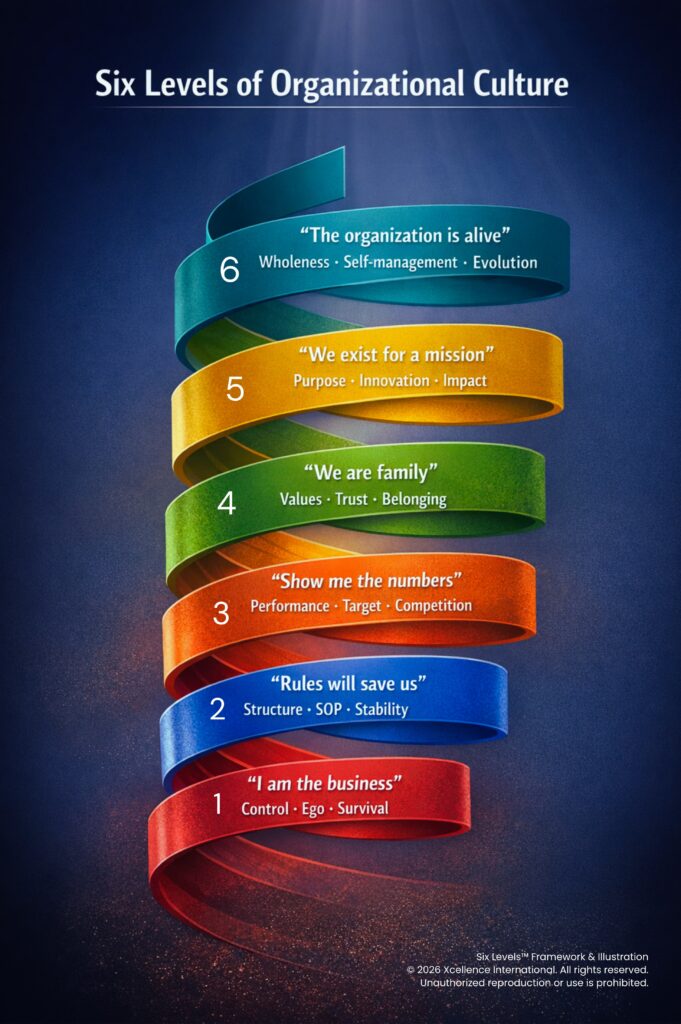
“I am the business” feels like devotion. It is actually the earliest and most forgivable trap in the 6 levels of culture, the one every leader starts in, and the one too many leaders never leave.
The lie is subtle. A founder believes he is protecting quality by staying involved in everything. What he is actually protecting is his own certainty, his own need to be the one who decides. Every time he solves a problem himself instead of building someone who can solve it, he is making the company weaker in exchange for feeling stronger himself.
The Cost Nobody Puts on the Balance Sheet
Employees in a founder-led culture learn one lesson fast: wait. Do not decide, escalate. Do not solve, ask. Not because they lack the ability, but because the founder has trained them, without meaning to, that decisions belong to him.
Then the founder gets sick, or tired, or simply wants a life. And the organization discovers it never actually had a team. It had an audience, watching one person work.
What the 6 Levels of Culture Framework Predicts Here
Every enterprise that scales past a few hundred people passes through this exact stage, whether it started as a family business, a founder-led startup, or a division built entirely around one dominant personality. The 6 levels of culture model does not treat this as a leadership flaw to be ashamed of. It treats it as level one of six, the level every organization starts at, and the level that predicts everything that goes wrong next if a leader mistakes it for a permanent identity instead of a starting point to grow out of.
Why the Team Never Actually Grows
Here is what makes a founder-led culture so hard to diagnose from the inside: it does not look broken. Revenue climbs. Clients stay. The founder is proud, exhausted, and secretly a little addicted to being needed. Nobody files a complaint about a system that is working.
But watch what happens in a meeting when the founder is not in the room. Decisions stall. People wait. Someone says “let’s check with him first” about a choice that should never have required checking with anyone. That sentence is the whole diagnosis. The team has learned, correctly, that thinking is not their job. Following is.
This is not a talent problem. Most founder-led companies are full of capable people. It is an authority problem. Nobody has ever been handed a decision large enough to fail at, so nobody has ever been forced to grow into one.
The Successor Who Inherits a Title, Not a Company
Family business researchers see this pattern constantly at the handoff point. A son or daughter, a hand-picked deputy, a trusted number two, takes the title. The org chart says they are in charge. But every employee still routes the real decisions to the founder, formally retired or not, because that is the pattern the culture actually rewards.
The successor inherits an office. They do not inherit the authority, because the authority was never distributed while the founder was still alive to distribute it. That is a culture problem wearing a succession-planning costume.
The Way Out
The fix is not stepping back and hoping the team steps up. That is how businesses die quietly instead of quickly. The fix is deliberately transferring the decisions, one at a time, starting with the ones that scare the founder most to let go of.
This is precisely the gap explored in Founder Dependency: The Real Reason Your Business Won’t Scale Without You, and it is the first rung on the 6 levels of culture ladder that every enterprise eventually has to climb.
Marcus survived his stroke. His company barely survived the six weeks he was gone. He spent the next year doing something harder than building the business the first time, teaching it to run without him, decision by decision, until the founder-led culture that built the company stopped being the same culture holding it hostage. Most founders do not get the warning first. They get the collapse.
Frequently Asked Questions
What is founder-led culture?
Founder-led culture is Level 1 of the 6 Levels of Culture framework: an organization where every meaningful decision routes through one person’s judgment. It moves fast at small scale and becomes a single point of failure at larger scale. Research from Cornell’s Smith Family Business Institute found nearly half of family business collapses trace back to the founder’s death or sudden absence.
How do you fix founder dependency without losing what made the company work?
You transfer decisions deliberately, one at a time, starting with the ones that scare the founder most to let go of. The full mechanics are in Founder Dependency: The Real Reason Your Business Won’t Scale Without You.
What culture level should a scaling company move toward?
There is no single universal target, but the leadership habits that work at $2 million in revenue rarely survive to $50 million. See When Organizational Growth Outpaces Leadership Maturity for how the required maturity shifts stage by stage.
Which decisions in your company still wait for you personally? Start there. Book a Strategic Conversation with Xcellence International before your body forces the question for you.