The survey came back glowing. Ninety-one percent of employees said they felt “aligned with company values.” The CEO printed the results and hung them outside the boardroom. Six months later, half the leadership team had quietly resigned, and the survey had predicted none of it.
This is the quiet failure hiding inside almost every culture maturity assessment ever run at an enterprise: it measures what people are willing to say in a survey, not what the organization actually does when nobody is watching.
Why the Standard Survey Cannot See the Real Answer
Most culture maturity assessment tools ask employees to rate statements like “leadership communicates openly” on a scale of one to five. The problem is not the scale. Research published in Harvard Business Review found that employee self-reports are often unreliable, because the values people say are important to them are frequently not reflected in how they actually behave.
A culture maturity assessment built on self-report is measuring performance of alignment, not alignment itself. Employees have learned, in almost every organization, which answers keep them safe. A survey cannot out-design that instinct.
The One Question a Survey Cannot Fake
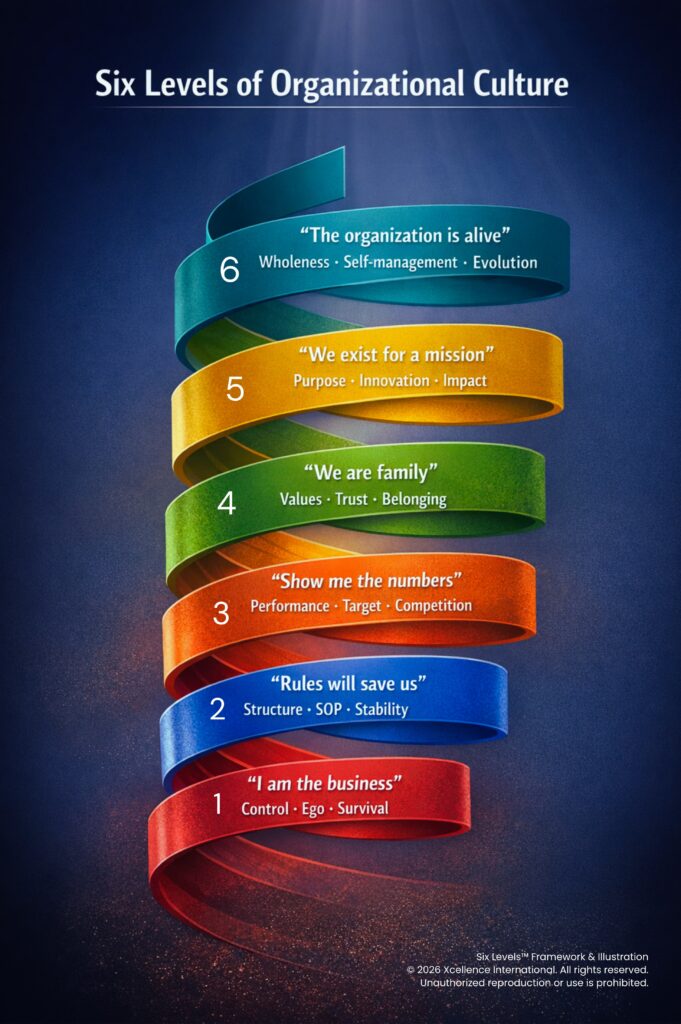
Here is the diagnostic that actually works, and it costs nothing to run. Watch what happens the next time something breaks that is nobody’s specific job to fix. Does the team wait for permission, quote a rule word for word, chase a number regardless of cost, protect a colleague’s feelings above the truth, chase a mission until they burn out, or simply handle it, because the authority to act was never a question.
That single moment of real behavior tells you more than a hundred survey responses, because nobody has time to perform for an audience during an actual crisis. A proper culture maturity assessment starts here, with observed behavior under pressure, not with a Likert scale filled out in a quiet office on a Tuesday afternoon.
The Metric Every Assessment Should Include and Almost None Do
Ask a different question entirely: how many decisions in this company currently require your personal approval that genuinely should not? Most executives cannot answer this quickly, which is itself diagnostic. A culture maturity assessment worth running should force leadership to count, specifically, the decisions still routed through one person’s desk that a competent team could make without them.
Why Assessments Fail at Multinational Scale
A single culture maturity assessment sent to every region and translated into six languages will return six different sets of politeness norms, not six honest pictures of the same underlying reality. A team in one market may score high on “psychological safety” simply because disagreeing with a superior is culturally taboo there, not because the culture is actually safer. Enterprise leaders who treat a global survey score as directly comparable across markets are comparing cultural politeness, not organizational maturity.
The Consultant Who Sells You the Wrong Kind of Assessment
An entire industry exists to sell enterprises a slicker version of the same broken instrument: more questions, prettier dashboards, benchmarking against “industry norms” that were collected the same flawed way. A culture maturity assessment does not become more accurate by adding more self-report questions to it. It becomes more accurate by adding less survey and more observed reality.
The most expensive assessments on the market are often the ones leaning hardest into this trap, because a 200-question survey with a polished PDF report looks rigorous. Rigor and accuracy are not the same thing. A culture maturity assessment can be extremely rigorous about measuring the wrong variable.
What Leaders Actually Do With a Bad Assessment
The real damage happens after the survey, not during it. A leadership team that receives a glowing culture maturity assessment stops looking for problems, precisely at the moment problems are quietly accumulating. The report becomes a shield against uncomfortable questions rather than a tool for finding them. “Our engagement score is in the 90th percentile” becomes the sentence that ends a conversation that should have just started.
This is worse than having no assessment at all. An organization with no data at least knows it is flying blind. An organization with a bad culture maturity assessment believes it can see, right up until the resignation wave, the scandal, or the star performer who finally breaks in public.
What This Predicts on the 6 Levels of Culture
A real 6 levels of culture assessment does not start with a questionnaire. It starts with three specific incidents from the last quarter, examined in detail: what actually happened, who actually decided, and what that decision reveals about which level the organization is really operating at, regardless of what the engagement survey says.
The CEO with the ninety-one percent alignment score never asked that question. He asked employees to rate a feeling. He never asked them to describe an actual decision. That is the entire difference between a culture maturity assessment that predicts a resignation wave and one that gets printed and hung outside a boardroom six months before the wave arrives.
Frequently Asked Questions
Why do culture surveys miss the real problem?
Because they measure what employees are willing to say, not what the organization actually does under pressure. Harvard Business Review found employee self-reports are often unreliable, since the values people say matter to them are frequently not reflected in how they actually behave.
What is a better way to run a culture maturity assessment?
Start with three specific incidents from the last quarter: what actually happened, who actually decided, and what that decision reveals about which level the organization is really operating at. That single test beats a hundred survey responses.
Why do culture assessments fail at multinational scale?
A single survey translated into six languages returns six different politeness norms, not six honest pictures of the same reality. A high “psychological safety” score in one market can simply reflect that disagreeing with a superior is culturally taboo there. See Multinational Culture Stagnation: The Level 2-3 Trap.
What did your last three unassigned problems actually reveal about who really has authority in your company, and would your leadership team even be able to name those three incidents if asked right now? Book a Strategic Conversation with Xcellence International and run the assessment that looks at behavior, not the one that only measures what people are willing to say out loud.