A Buurtzorg nurse decides, on her own authority, to add a second weekly visit for a patient whose condition has quietly worsened. No manager approves it. No committee reviews it. There is no manager to approve it, and no committee to review it, because the twelve-person team she belongs to hires its own members, sets its own budget, and resolves its own conflicts, without a single layer of management standing between the nurse and the decision.
This sounds like it should not work at scale. It does. Buurtzorg grew to more than ten thousand nurses across nearly nine hundred of these self-managed teams, and in doing so proved something most executives find almost impossible to believe: a self-managed organization is not a smaller, riskier version of a normal company. It can be a more disciplined one.
The Number That Should Embarrass Every Layer of Middle Management
Peer-reviewed research on Buurtzorg’s scaling model found the organization ran overhead of roughly 8 percent, against an industry average closer to 25 percent, while independent analysis found it delivered care at close to 40 percent lower cost than conventional providers, posting some of the highest patient and employee satisfaction scores in its market. A self-managed organization did not succeed despite removing management. The removal of management was the mechanism, not the risk.
The Enterprise Objection That Sounds Reasonable and Is Usually Wrong
Executives at large multinationals hear the Buurtzorg story and immediately object: healthcare in one country is not the same as running a global supply chain, or a 20,000-person manufacturing operation, or a multi-brand retail portfolio. That objection is fair on the surface and misses the actual point. Buurtzorg is not a template to copy wholesale. It is proof that the assumption underneath most corporate hierarchies, that competent adults cannot be trusted to run their own unit without a supervisor, is an assumption, not a law of organizational physics.
A self-managed organization does not require every function at every scale to look like a Dutch home-care team. It requires leaders to stop treating hierarchy as the default and start treating it as one design choice among several, applied deliberately to the units where it still adds more value than it costs.
Why This Level Is So Rare
Every level before this one still has someone standing above the team, coordinating, approving, protecting quality from a position of authority. A self-managed organization removes that position entirely, and asks a team to hold its own standard without anyone standing over it to enforce one. Most leaders who reach level five, running purpose-driven teams that would already look impressive to a competitor, quietly stop there, because letting go of the final layer of control is the hardest handoff any of the six levels demands.
It is not a technology problem or a talent problem. It is almost always a leader’s own identity problem. A career spent earning the authority to decide does not prepare anyone to voluntarily give that authority away.
What Actually Replaces the Manager
A self-managed organization does not run on good intentions instead of structure. It runs on different structure entirely: shared information systems that give every team direct access to the data a manager used to gatekeep, small coaching functions with zero authority to overrule a team, and a level of peer accountability that a hierarchy never had to build because the hierarchy did that job instead.
Remove the coaches, remove the information systems, and copy only the flat org chart, and a self-managed organization collapses within a year. Executives who admire the model and try to shortcut it by simply deleting management layers are copying the least important part of what actually makes it work.
The Coach Nobody Told You to Hire
The single most overlooked detail in the Buurtzorg model is the role that replaces the manager: a small internal coaching function, roughly one coach for every forty to fifty teams, with zero authority to make a decision for the team. The coach cannot override a hire. The coach cannot approve a budget. The coach exists purely to be a sounding board when a team gets stuck.
Most enterprises attempting a self-managed organization skip this role entirely, assuming that removing managers means removing the need for any support function at all. That assumption is precisely why so many self-management pilots quietly fail within their first year, then get quoted internally as proof the model “doesn’t work here.”
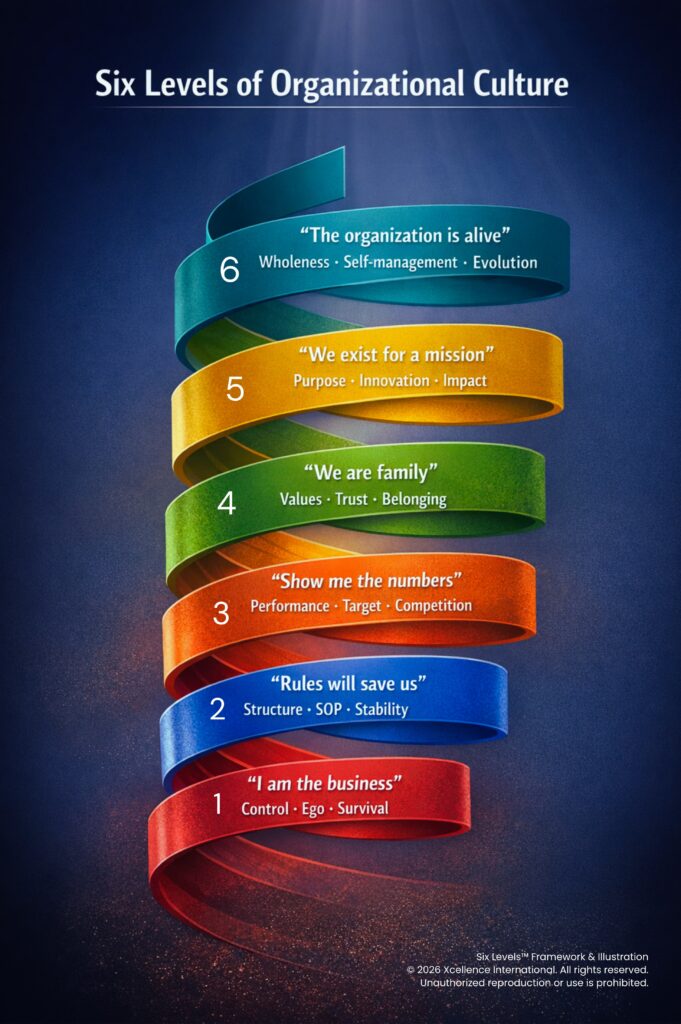
What This Predicts on the 6 Levels of Culture
This is level six of the 6 levels of culture, the rarest level in any enterprise, and the hardest to fake. A self-managed organization is not the end of a maturity checklist to complete quickly. It is a different relationship to authority entirely, one most companies with 300 to 30,000 employees will never fully reach, and do not necessarily need to reach everywhere at once.
The realistic goal for most enterprise leaders is not converting the entire company into a self-managed organization overnight. It is identifying which units are already capable of it, and building the information and coaching infrastructure that lets authority move without a manager standing in the way, one team at a time.
Frequently Asked Questions
What is a self-managed organization?
A self-managed organization is Level 6 of the 6 levels of culture, the level after purpose-driven culture: teams hire, budget, and resolve conflict with no manager in the loop. Buurtzorg proved it at scale, running roughly 8 percent overhead against an industry average near 25 percent, across nearly 900 self-managed teams.
What actually replaces the manager in a self-managed organization?
Shared information systems that give every team direct access to data a manager used to gatekeep, plus a small coaching function with zero authority to overrule a team, roughly one coach per 40 to 50 teams. Remove those and copy only the flat org chart, and the model collapses within a year.
How do you know if your organization is ready to try self-management?
Start by finding out which culture level your teams are actually operating at today, not which one leadership assumes. See Culture Maturity Assessment: What Surveys Always Miss.
Which team in your organization already makes better decisions without you than with you? Book a Strategic Conversation with Xcellence International and find out how far toward level six your best people are already quietly capable of going.