Nobody told Elena she was fired. Not exactly. Her manager kept extending her “development plan” for eleven months, hoping she would improve on her own, or quietly leave, or something, anything, other than requiring the manager to have the conversation everyone in the department had been avoiding since her third missed deadline. “We’re a family here,” the company said in every onboarding deck. What that actually meant, in practice, was that nobody was allowed to say the hard thing out loud.
This is the trap hiding inside every family culture business risk, the level that feels like the healthiest one an organization has ever reached, right up until it quietly stops being honest.
Why This Level Feels Like Arrival
After the metrics wars of a performance-driven culture, arriving at a family culture feels like relief. Trust returns. People genuinely like coming to work. Core values replace KPIs as the thing that gets talked about in meetings, and for the first time, employees feel like the company actually cares whether they are okay, not just whether they hit their number.
This stage produces genuinely loyal people, the kind who stay through hard years out of real affection, not contractual obligation. That loyalty is not fake. It is also not the whole story, and it is rarely enough on its own to keep an enterprise competitive once the market stops rewarding warmth and starts rewarding speed.
The Cost Hiding Inside the Warmth
Research on family-like company cultures keeps finding the same pattern. As one workplace culture study on team dynamics found, the need for harmony ends up outweighing honest dialogue, and challenging a colleague starts to feel like betraying the family rather than doing the job. A family culture business risk rarely looks like conflict. It looks like everyone being too kind to say the one sentence that would actually fix the problem.
The Multinational Version of the Same Trap
This is not only a small-team phenomenon. Regional offices inside large multinationals develop the exact same family culture business risk at scale, especially in markets where long-tenured local leaders are treated as beloved elders rather than accountable executives. Head office sees loyalty and low turnover and assumes health. What is actually happening on the ground is a decade of unaddressed underperformance, quietly protected by everyone’s genuine affection for the person underperforming.
By the time headquarters notices the regional numbers have flatlined for three years, the family culture business risk has already cost the company a market position a more accountable competitor was happy to take.
Underperformance goes unaddressed for months, sometimes years, because addressing it feels like an act of cruelty rather than an act of leadership. Standards quietly slide, one generous exception at a time, until the exception has become the new normal and nobody remembers what the actual standard used to be.
Why Managers Freeze
A manager inside a family culture business risk is not avoiding the hard conversation because they are weak. They are avoiding it because the entire culture has trained them to believe that confrontation equals disloyalty. Every incentive in the building rewards being liked. None of them reward being the one who says the uncomfortable true thing in the room.
So problems get managed around instead of solved. A struggling employee gets quietly reassigned instead of coached. A toxic high performer gets tolerated because firing them would “hurt team morale,” even while their behavior is actively damaging it. A family culture business risk protects feelings today at the direct expense of the company’s ability to function tomorrow.
The Talent That Quietly Leaves
Here is the group a family culture business risk loses fastest, and rarely notices losing: the high performers who came for growth and stayed for connection, then realized connection was never going to translate into anyone being held to a real standard. They do not complain on the way out. They just stop applying for the next role up, because the ceiling was never about ability. It was about how uncomfortable it would be to promote them past a peer who needed the job more.
What This Predicts on the 6 Levels of Culture
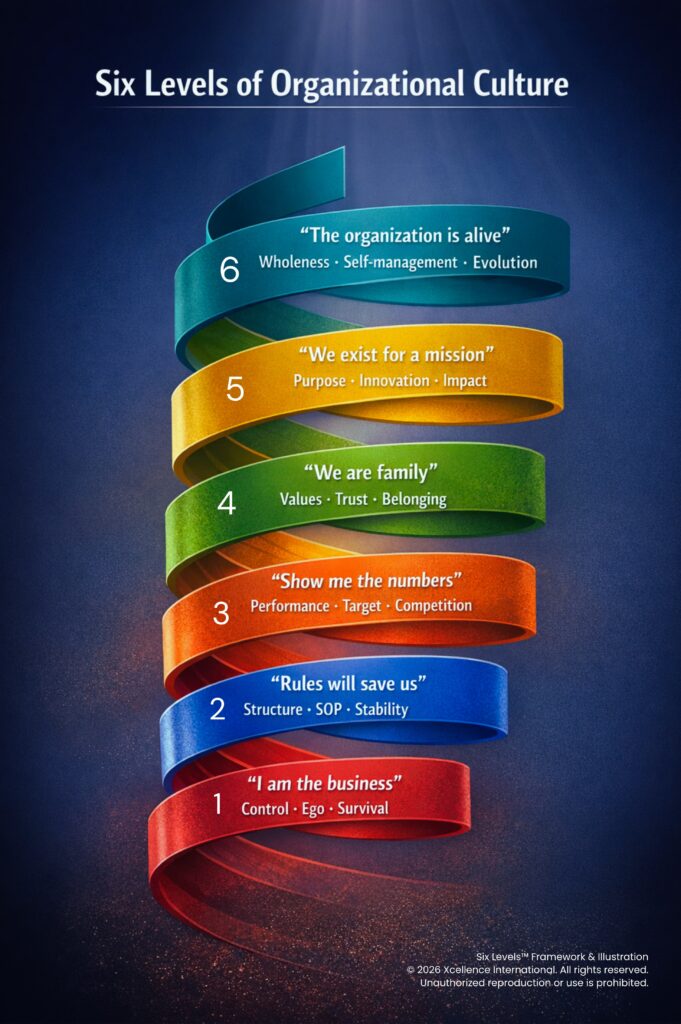
This is level four of the 6 levels of culture, and it is one of the hardest levels to diagnose from inside, because everyone genuinely likes each other and the company genuinely feels good to work for. A family culture business risk does not announce itself as dysfunction. It announces itself as warmth, right up until a competitor with less warmth and more accountability eats the market share nobody was defending.
The fix is not colder leadership. It is learning to hold both at once, the care that made the culture worth staying for, and the honesty that makes an organization worth staying employed at. Elena eventually left on her own, quietly, after finally realizing nobody was ever going to tell her the truth she needed to hear a year earlier. Her manager still talks about her fondly. He also still has not learned to say the hard thing to the next Elena on his team.
Frequently Asked Questions
What is family culture business risk?
Family culture is Level 4 of the 6 levels of culture: trust and belonging replace the KPI-driven competition of performance-driven culture. It produces genuine loyalty, but the need for harmony ends up outweighing honest dialogue, so underperformance and toxic behavior both go unaddressed in the name of kindness.
Why do managers freeze in a family culture?
Not because they are weak, but because the culture has trained them to believe confrontation equals disloyalty. Every incentive in the building rewards being liked; none reward being the one who says the uncomfortable true thing in the room.
What comes after family culture?
Level 5, purpose-driven culture, replaces belonging with a shared mission bigger than any one person. It restores the edge that family culture lost, but introduces a new risk: burnout with no natural ceiling. See Purpose-Driven Culture: The Mission That Has No Ceiling.
Which hard conversation has your culture been postponing in the name of kindness, and which quiet exception from three years ago has now become the standard nobody remembers agreeing to? Book a Strategic Conversation with Xcellence International before the cost of that kindness shows up on next year’s numbers.