The regional VP had the same conversation in Jakarta, Manila, and Ho Chi Minh City within the same quarter, almost word for word, three markets, three different regional leadership teams, one identical complaint. “Headquarters wants growth. Headquarters also wants every decision above five thousand dollars routed through three approvals.” Nobody at headquarters saw the contradiction. Every regional office lived inside it daily.
This is the exact trap most multinational culture stagnation gets built from: a company that talks like it wants to perform, while every actual system still runs like it wants to be obeyed.
Why Multinationals Land Here So Often
A single-market company can move cleanly through the levels, chaos to rules to metrics, because one leadership team makes the call and the whole organization moves together. A multinational rarely gets that luxury. Headquarters may have genuinely evolved into a performance-driven culture, chasing global KPIs and rewarding measurable results. Meanwhile, three acquired regional offices are still running the rule-bound culture they had before the acquisition, because nobody ever actually integrated them, just added their revenue to a consolidated spreadsheet.
Multinational culture stagnation is rarely a single company failing to evolve. It is several companies, at several different levels, wearing one shared logo, each one convinced the other is the problem.
The Contradiction No One Names Out Loud
Here is what makes this so hard to fix: headquarters genuinely believes it has moved past bureaucracy, because its own executive layer operates on results and speed. What headquarters does not see is that every approval workflow, every finance policy, every legal sign-off chain it built to protect itself from regional risk is still pure level-two thinking, rules replacing trust, applied globally to markets that headquarters barely understands.
A regional GM in a fast-moving Southeast Asian market is being measured like a level-three performer while being controlled like a level-two subordinate. Multinational culture stagnation lives exactly in that gap, and it is invisible from the headquarters floor where the policies were written with good intentions.
Why the Fastest Regional Talent Leaves First
The regional leaders most capable of actually performing at the level headquarters claims to want are the ones who feel the contradiction most acutely, and they leave fastest. They did not sign up to ask permission for decisions a local competitor’s manager makes without a second thought. Multinational culture stagnation quietly filters for the wrong trait over time: it keeps the leaders who tolerate the bureaucracy and loses the ones who could have out-executed the local competition.
The Acquisition That Never Actually Integrated
This pattern shows up hardest after M&A. A parent company acquires a regional player specifically for its market-savvy, fast-moving culture, then spends the next three years quietly forcing that culture through the parent’s approval chain until the acquired team’s decision-making speed, the exact asset that made the acquisition attractive, has been fully bureaucratized away. MIT Sloan Management Review’s analysis of thousands of deals found that 46 percent of all M&A transactions are ultimately undone, with cultural mismatch as one of the two most predictable root causes. Multinational culture stagnation is often the slow death of the very thing a company paid a premium to acquire.
Why Headquarters Cannot See Its Own Blind Spot
Executives at headquarters rarely experience the contradiction themselves, because their own daily work genuinely does run on results and speed. A regional finance director in Manila, however, experiences the full weight of a five-signature approval chain for a routine vendor payment, while being told in the same quarterly review that the region needs to “move faster and act like owners.” Multinational culture stagnation persists precisely because the people with the authority to fix it are the ones least exposed to its daily cost.
This is not a communication problem that a better town hall slide deck will solve. It is a structural one. The approval chain was built by people managing risk from a distance, for a market they visit twice a year, and it will keep producing the same stagnation until someone actually measures which controls are protecting the company and which ones are only protecting headquarters’ comfort.
What This Predicts on the 6 Levels of Culture
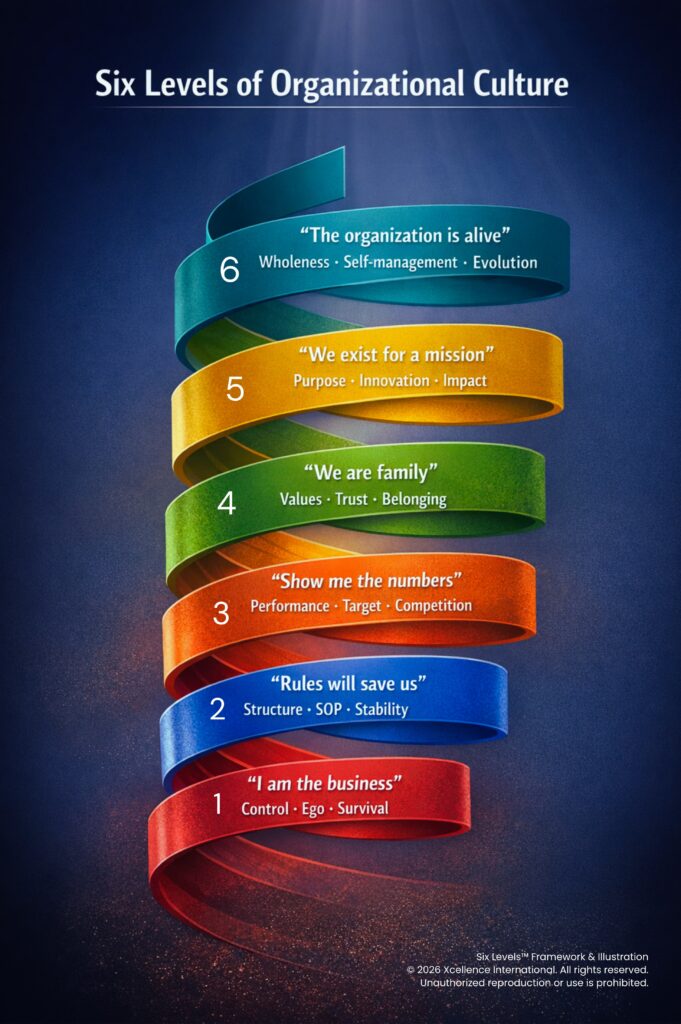
This is the collision point most enterprises never diagnose correctly on the 6 levels of culture map: headquarters at level three, regional operations still at level two, both blaming the other for results that never fully materialize. The fix is not another global town hall about “one culture.” It is an honest map of which level each region is actually operating at, and a decision about which controls genuinely protect the company versus which ones only protect headquarters from having to trust a market it does not fully understand.
The regional VP eventually got headquarters to remove the three-approval rule for decisions under fifty thousand dollars, market by market, starting with the fastest-growing region first. Revenue in that region grew faster in the following two quarters than it had in the previous two years combined.
Frequently Asked Questions
What is multinational culture stagnation?
It is what happens when headquarters operates at one culture level while regional offices still run on a different one, usually after an acquisition that was never fully integrated. Headquarters believes it has moved past bureaucracy while its own approval chains still impose Level 2 control on regions it is measuring like Level 3 performers.
Why does this problem show up hardest after M&A?
MIT Sloan Management Review’s analysis of thousands of deals found 46 percent of all M&A transactions are ultimately undone, with cultural mismatch as one of the two most predictable root causes. The acquired team’s fast decision-making, the exact asset the deal was meant to capture, gets bureaucratized away.
How do you diagnose which level each region is actually operating at?
Not with a global survey translated into six languages, since that measures politeness norms, not maturity. Run the same behavioral diagnostic used across the whole framework: see Culture Maturity Assessment: What Surveys Always Miss and When Organizational Growth Outpaces Leadership Maturity.
Which of your regions is being measured like a performer and controlled like a subordinate, and how many of your approval chains exist to protect the company versus protect headquarters from a market it has never had to fully trust? Book a Strategic Conversation with Xcellence International and find out where the real collision is happening in your organization.