Priya followed the manual exactly. Step four before step five. Sign-off from her supervisor before touching the account. Escalate, never decide. When the client called in a panic over a shipment that would miss its deadline by six hours unless someone broke protocol and released it early, Priya did exactly what four years of training had taught her to do. She waited for approval. The approval came the next morning. The client was gone by lunch, the account with them.
Nobody at that company would call Priya lazy. She followed every rule perfectly. That was the entire problem, and it is the exact trap hiding inside every bureaucratic company culture that mistakes compliance for competence.
Why the Rules Showed Up in the First Place
Rules do not appear out of nowhere. They appear because chaos got expensive. A founder-led culture running on one person’s judgment eventually breaks something too costly to break twice, and someone, usually a newly hired ops director, writes it down so it never happens again.
For a while, this feels like salvation. Onboarding gets faster. Quality gets consistent. The founder can finally take a real vacation, because the SOP tells everyone exactly what to do in his absence. A bureaucratic company culture, in its early days, is not the enemy. It is the cure for the chaos that came before it.
Where the Cure Becomes the Disease
The trouble starts the moment the rule outlives the reason it was written. Nobody remembers why step four comes before step five. Nobody is allowed to ask. The manual has become the authority, and questioning the manual has quietly become the same offense as questioning the founder used to be.
Gallup’s 2026 workplace research found global employee engagement has now fallen for two straight years, the first time that has ever happened in the survey’s history. A bureaucratic company culture is rarely the sole cause, but it is a reliable accelerant, because nothing disengages a capable employee faster than being trusted with nothing. It is also why bad news stops reaching the top of these companies long before an engagement score ever catches it: see Information Distortion in Large Organizations: Why Leaders Only Hear Good News.
The Employee Who Stops Thinking on Purpose
Here is what almost never gets said out loud in a compliance review: employees in a bureaucratic company culture are not failing to think. They are choosing not to, because thinking has been punished before. Someone improvised once, it went wrong, and the lesson the whole department absorbed was not “improvise more carefully.” It was “never improvise again.”
So the smartest people in the building start doing the least imaginative version of their job, on purpose, as a survival strategy. That is not a talent gap. That is a rational response to an incentive structure that rewards obedience and quietly punishes judgment.
The Silo That No One Designed
Rules also draw lines, and lines become walls. Each department protects its own procedure, its own approval chain, its own definition of “not my job.” A bureaucratic company culture does not usually collapse in one dramatic failure. It calcifies, department by department, until the company can execute its own manual perfectly while losing to a competitor who never wrote one down.
The Meeting That Reveals Everything
Sit in on a decision review at a company running a bureaucratic company culture and you will hear a very specific sentence repeated in different words: “that’s not really my call.” It is said politely. It is said by capable, intelligent people. And it is the sound of an organization that has trained its own talent out of using it.
Contrast that with a company one level up, where the same kind of decision gets made on the spot, by whoever is closest to the problem, because the culture has decided that competence matters more than hierarchy. The difference between those two rooms is not headcount or budget. It is what the culture has quietly taught people is safe to do.
Why Leaders Defend the Very Rules Hurting Them
Leaders in a bureaucratic company culture often know, at some level, that the rulebook has become a liability. They defend it anyway, because the alternative feels like losing control. Structure was the thing that saved the company from founder-led chaos, so loosening it feels like inviting the chaos back in.
That fear is understandable and almost always wrong. The choice was never between rigid rules and no rules. It was between rules that serve judgment and rules that replace it. A bureaucratic company culture forgets there was ever a third option.
What This Predicts on the 6 Levels of Culture
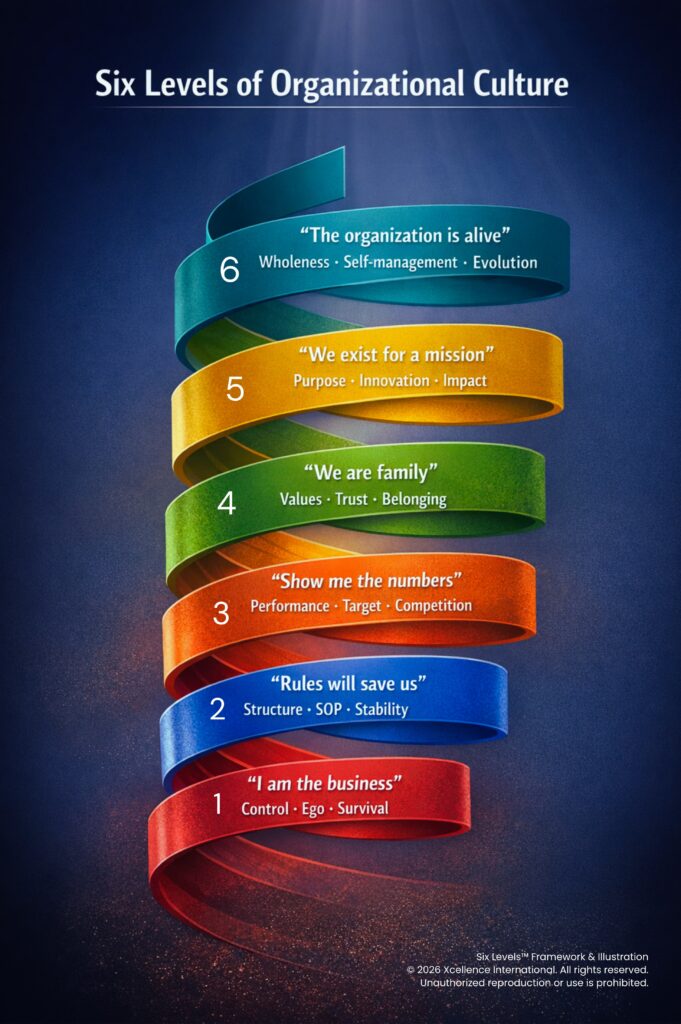
This is level two of the 6 levels of culture, and it is usually a step up from the founder-led chaos that came before it. But a stable company can still be dying, and a bureaucratic company culture is one of the most convincing ways to die slowly while every metric on the dashboard says everything is fine.
The fix is not deleting every rule. It is asking, department by department, which rules still protect the company and which ones now only protect someone’s need to avoid a hard conversation. Priya’s manual was not wrong to exist. It was wrong to still be treated as sacred four years after the reason for it had disappeared.
Frequently Asked Questions
What is bureaucratic company culture?
Bureaucratic company culture is Level 2 of the 6 levels of culture: structure and SOPs replace one founder’s judgment. It is the cure for the chaos of founder-led culture, but it calcifies once rules outlive the reason they were written. Gallup’s 2026 workplace research found global employee engagement has now fallen for two straight years running, the first time that has happened in the survey’s history.
How do you know if your rules have become the problem?
Sit in a decision review and listen for “that’s not really my call,” said politely by capable people about decisions they are qualified to make. That sentence, repeated often, is the diagnostic. Full walkthrough: Culture Maturity Assessment: What Surveys Always Miss.
What comes after bureaucratic culture?
Level 3, performance-driven culture, trades rigid rules for KPIs and meritocracy. It fixes the paralysis of Level 2 but introduces a different risk: office politics and burnout. See Performance-Driven Culture Risk: The Cost of Chasing KPIs.
Where in your organization is the rule older than the reason for it? That question is worth more than another audit. Book a Strategic Conversation with Xcellence International and find out which rules are protecting you, and which ones are protecting nothing but themselves.