Sarah booked her flight to the leadership offsite from the hospital hallway, between her father’s second and third surgery. Nobody asked her to. She wanted to be there, because the mission mattered more to her than almost anything else in her life at that moment, including, she later admitted, her own exhaustion. Eighteen months later she quit without notice, on a Tuesday, and would not say why in the exit interview. Everyone assumed money. It was never money.
This is the paradox sitting at the center of every purpose-driven culture: it produces the most devoted people an organization will ever have, and it can burn every one of them out without a single manager doing anything that looks, on paper, like mismanagement.
Why This Level Outperforms Everything Before It
A purpose-driven culture pulls in a different caliber of person than the levels before it. Not employees looking for stability or even for recognition, but people who want to be part of something that will not exist without them. The alignment this produces is extraordinary. Meetings run on genuine conviction instead of politics. People solve problems at 11pm because they want to, not because a KPI is threatening their bonus.
Research published in Harvard Business Review found that one in five highly engaged employees also reports high burnout, a group researchers call “engaged exhausted.” A purpose-driven culture manufactures exactly this profile at scale, because the same conviction that makes someone extraordinary also makes them terrible at noticing their own limits.
The Ceiling That Was Never Built
Every level before this one has a natural brake. Rules cap what a bureaucratic culture can demand of someone. Metrics cap what a performance-driven culture can extract, because eventually the number itself sets a limit. A purpose-driven culture has no equivalent brake, because the mission is, by design, bigger than any one person could ever finish. There is always more to do, and someone who believes in the mission will always find a reason to do it.
Leaders inside a purpose-driven culture rarely intend to run people into the ground. They simply never build a mechanism to say stop, because saying stop feels like betraying the very thing that makes the culture special.
Why the Best People Break First
Here is what makes a purpose-driven culture especially dangerous: it does not lose its weakest performers to burnout. It loses its strongest ones, the Sarahs, the people who cared enough to sacrifice sleep, relationships, and eventually their own health for a mission nobody forced them to adopt. By the time they leave, the exit interview cannot capture what actually happened, because “I believed in this too much, for too long, with no one checking on me” does not fit in a dropdown menu.
The Global Version of This Trap
Multinational organizations that adopt a genuine purpose-driven culture face a version of this problem most local companies never encounter: the mission crosses time zones, and so does the guilt. A star performer in Singapore answers a message from headquarters at 2am because the mission does not observe office hours, and neither, apparently, does she. Nobody flagged this in a policy document. The culture simply made staying available feel like devotion, and devotion feel like identity.
Leaders traveling between regions often see the exhaustion firsthand and still fail to intervene, because intervening feels like questioning someone’s commitment to the very thing that makes them exceptional. A purpose-driven culture at global scale multiplies this dynamic across every market the company operates in, invisibly, until the resignations start clustering in a pattern no one connects until it is too late to reverse.
Why Traditional HR Tools Miss This Entirely
Standard engagement surveys are actively unhelpful here, because they ask whether someone is engaged, and a purpose-driven culture produces employees who will answer that question enthusiastically right up until the week they resign. Engagement and exhaustion are not opposites in this level. They are frequently the exact same person, answering the exact same survey, telling the exact same partial truth.
This is why exit interviews inside a purpose-driven culture so rarely produce a usable answer. The employee is not lying when they say they loved the mission. They are simply unable to say, inside a culture that never gave them permission to say it, that loving the mission and surviving it turned out to be two different things.
What This Predicts on the 6 Levels of Culture
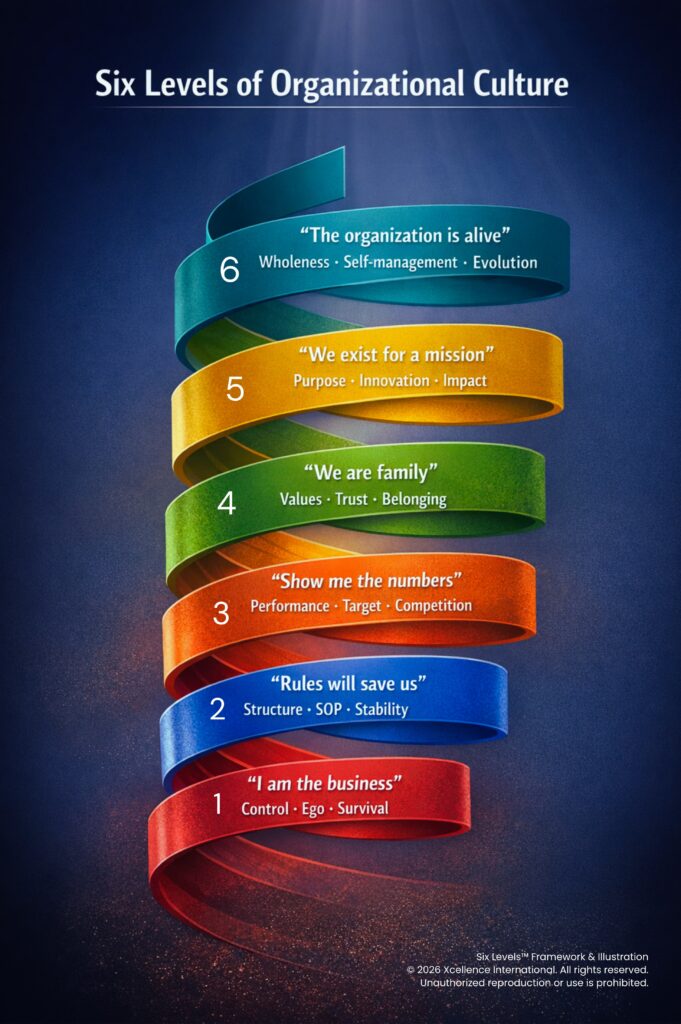
This is level five of the 6 levels of culture, and it is the level most leaders privately wish every level looked like, right up until they watch their most devoted people quietly disappear one at a time. A purpose-driven culture is not a mistake to avoid. It is a stage that has to be managed with more care than any level before it, precisely because the people inside it will not protect themselves.
The fix is not lowering the ambition of the mission. It is building the one thing a purpose-driven culture almost never has on its own: someone whose actual job is to notice who is about to break, and to say stop before the person says it for themselves by quitting on a Tuesday with no notice.
Frequently Asked Questions
What is purpose-driven culture?
Purpose-driven culture is Level 5 of the 6 levels of culture: a mission bigger than any one person replaces the belonging of family culture. It produces extraordinary alignment, but Harvard Business Review found one in five highly engaged employees also reports high burnout, a group researchers call “engaged exhausted,” and this level manufactures that profile at scale.
Why does purpose-driven culture burn out the best people first?
It loses its strongest performers, not its weakest, because the same conviction that makes someone extraordinary also makes them terrible at noticing their own limits. Standard engagement surveys miss this entirely, since engaged and exhausted are frequently the same person.
What comes after purpose-driven culture?
Level 6, self-managed organization, removes the final layer of management entirely and distributes authority to the team closest to the decision. It is the rarest level in any enterprise. See Self-Managed Organization: The Rarest Culture Level.
Who on your team is currently running on belief instead of capacity, and who is watching them do it without saying anything? Book a Strategic Conversation with Xcellence International before your most devoted people teach you the hard way that purpose without limits is not sustainable, it is a countdown.