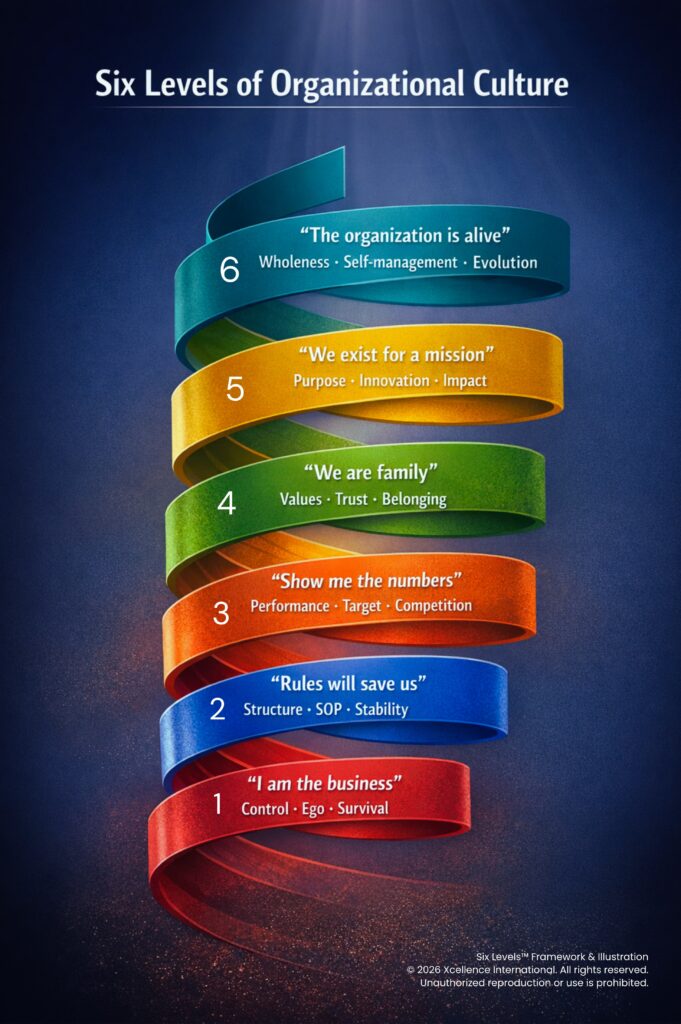
A CHRO at a Zurich-based logistics group said it to my face during a workshop break, not unkindly, just certain: “Isn’t this just Spiral Dynamics with better branding?” The room went quiet the way rooms do when someone says the thing three other people were already thinking.
She was half right, and that half-right answer about 6 levels of culture vs Spiral Dynamics is exactly why so many good frameworks die in a boardroom before they ever reach the factory floor.
Where the Lineage Actually Comes From
Yes, the color-coded stage model traces back to Clare Graves, then Don Beck and Christopher Cowan’s Spiral Dynamics, then Frederic Laloux’s Reinventing Organizations, which studied roughly a dozen “Teal” organizations and became a management bestseller. 6 levels of culture vs Spiral Dynamics is not a competition between two unrelated ideas. It is one lineage, and pretending otherwise would be dishonest.
Why Most Consultants Never Admit the Lineage
There is a commercial incentive to pretend a framework sprang from nowhere, fully original, with no debt to the thinkers who came before it. That incentive is exactly backwards. A framework’s value is not whether it is original. It is whether it produces a decision a leader can act on this quarter. 6 levels of culture vs Spiral Dynamics is a useful comparison precisely because it is honest about which one does which job.
Where the Two Actually Diverge
Here is where the CHRO’s comment stopped being accurate. Spiral Dynamics describes stages of human values development, a psychological theory about how people and societies evolve. Reinventing Organizations took that theory and applied it to companies, but critics have pointed out for a decade that the underlying stage model has no reliable scientific basis outside of general developmental psychology, and that Laloux’s own case studies do not always fit the model as cleanly as the book suggests. Even Corporate Rebels, who helped popularize the Teal conversation, now openly caution against treating any single organization as a “pure breed” of one level.
6 levels of culture takes a narrower, harder-edged position deliberately. It does not claim to describe the evolution of human consciousness. It describes one measurable variable: where authority actually lives inside a company, and what that company trusts to make a decision. That is a claim a CFO can test against real behavior in a single meeting, not a claim that requires believing in stages of enlightenment.
Why This Distinction Actually Matters to a CEO
A Fortune 500 executive does not need another theory of consciousness. They need a diagnostic they can run on Monday morning. Spiral Dynamics and its Teal descendants are genuinely useful for opening a leader’s mind to the idea that organizations can operate on fundamentally different logics. Where they struggle is translation, turning “we should be more Teal” into a decision someone actually has to make about who approves a budget line this quarter.
6 levels of culture exists specifically to close that gap. Every level maps to observable behavior, not aspiration. Level one is not a mystical stage of consciousness, it is a founder who still approves every hire personally. Level six is not enlightenment, it is a team that hires, budgets, and resolves conflict with no manager in the loop, the way Buurtzorg’s teams actually do, verifiably, in the real world.
The Honest Answer to the CHRO’s Question
So was she right? Partly. 6 levels of culture vs Spiral Dynamics is not a rivalry, it is a translation. One gives you the philosophy. The other gives you the org chart, the decision rights, and the specific behavior to change by Friday. Neither replaces the other, and any consultant who claims total originality while quietly standing on Graves, Beck, Cowan, and Laloux’s shoulders is not being straight with you.
A Test You Can Actually Run This Week
Here is the practical difference at the center of 6 levels of culture vs Spiral Dynamics. Spiral Dynamics asks you to identify a stage of consciousness, which requires training, certification, and often a facilitator in the room. 6 levels of culture asks one question any executive can answer without any certification at all: the next time something breaks that is nobody’s specific job to fix, who decides, and on what basis.
That single test tells you more about your actual operating level than a values survey ever will, and it does not require anyone in the room to accept a theory of human consciousness first. This is the entire reason 6 levels of culture vs Spiral Dynamics resolves in favor of the narrower framework for enterprise use, not because the philosophy behind Spiral Dynamics is wrong, but because a CEO with 4,000 employees across three continents needs Monday-morning traction, not a semester of theory.
What This Predicts for Enterprise Leaders
If your organization has already sat through a “Teal” workshop and walked away inspired but unsure what to actually do on Monday, that is not a failure of your team. It is the predictable gap between a philosophy of consciousness and an operating manual. 6 levels of culture was built to be the operating manual.
6 Levels of Culture vs Spiral Dynamics, Side by Side
| Dimension | Spiral Dynamics | 6 Levels of Culture |
|---|---|---|
| What it measures | Stages of human values development | Where authority actually lives inside a company |
| To apply it | Requires training and often a certified facilitator | One question any executive can answer without certification |
| Best used for | Opening a leader’s mind to different organizational logics | Running a diagnostic and making a decision this quarter |
| Evidence base | General developmental psychology, contested outside that field | Testable against specific incidents inside one company |
Frequently Asked Questions
Is the 6 Levels of Culture framework just Spiral Dynamics with a new name?
No, though the lineage is real and worth acknowledging. Spiral Dynamics traces through Clare Graves, then Beck and Cowan, then Laloux’s Reinventing Organizations. 6 Levels of Culture takes that lineage and narrows it to one testable variable an executive can act on this quarter, instead of a theory of human consciousness.
What does Level 6, self-managed, actually look like in a real company?
Teams that hire, budget, and resolve conflict with no manager in the loop, the way Buurtzorg’s roughly 900 home-care teams do at scale. See Self-Managed Organization: The Rarest Culture Level for the full case.
What is the fastest way to find out which level my company is actually at?
Skip the values survey. Run the behavioral diagnostic instead: watch who decides the next time something breaks that is nobody’s specific job to fix. Full method: Culture Maturity Assessment: What Surveys Always Miss.
The Zurich CHRO booked a follow-up session two weeks later. Not because the lineage had changed. Because she finally had a diagnostic her operations team could actually run. Which theory has your organization been inspired by without ever translating into a decision? Book a Strategic Conversation with Xcellence International and get the translation, not just the philosophy.